Universal Infrared - Knx Gateway
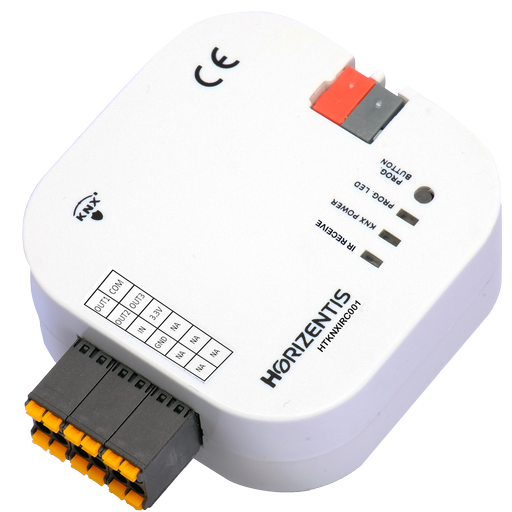
Developed for KNX, the HTKNXIRC001 offers powerful integration, bidirectional synchronization, and centralized remote management for all infrared-controlled consumer electronics and HVAC units.
Downloads
The HTKNXIRC001 is the indispensable link for integrating standard consumer electronics and non-KNX controlled systems such as TVs, music systems, projectors, and conventional air conditioning units into modern KNX building automation networks. Acting as a sophisticated control bridge, the gateway translates complex KNX control telegrams into universally understood infrared signals, enabling comprehensive control and scenario management across all your IR-dependent devices.
Key Differentiator: Bidirectional Synchronization
Unlike simple IR transmitters, the HTKNXIRC001 provides a critical advantage through its advanced bidirectional synchronization. Utilizing its external IR receiver, the gateway actively monitors and decodes control signals originating from the device's original handheld remote control. Commands executed manually by the user (e.g., adjusting the volume on a TV or changing the fan speed on an AC) are instantly translated into KNX status feedback (FB) telegrams and published to the bus. This ensures the entire KNX system remains fully synchronized, accurately reflecting the current operational state regardless of the control source.
The IR Repeater Engine: Precision Control and Flexibility
IR Codes – The Foundation
The "Codes" module serves as the gateway's library, capable of storing up to 64 distinct IR commands learned from any physical remote control. Codes can be individually read, written, or learned directly into the device memory. For efficient configuration, the entire library can be synchronized with ETS using the "Read All" and "Write All" functions. This feature simplifies backup and cloning, allowing integrators to manage the raw hexadecimal data of the IR commands, define carrier frequency, and verify the physical storage state.
IR Channels – Directional Logic and Feedback
The "Channels" module defines the operational bridge between KNX and IR. Each channel can be configured with a specific Working style:
- Knx -> Infrared: Controls an appliance by transmitting a stored IR signal upon receiving a KNX telegram.
- Infrared -> Knx: Uses a physical IR remote as an input device, sending a customizable KNX telegram (e.g., to control lighting or blinds) when a specific IR code is detected.
For enhanced user autonomy, the IR code self replacement feature allows end-users to update the stored IR code for a channel using a simple scene object, eliminating the need for an ETS service call when replacing an appliance (like upgrading a TV).
IR Macros – Multi-Step Automation
The "Macros" page allows for the creation of complex, sequential command chains. A Macro can execute a series of up to 8 distinct IR commands triggered by a single KNX telegram. This is ideal for scenario-based controls requiring precise timing and sequencing.
- Each part (1-8) can select a code number, define a Transmission delay (in x100ms steps), and set a Transmission count for repeating signals, ensuring command reliability.
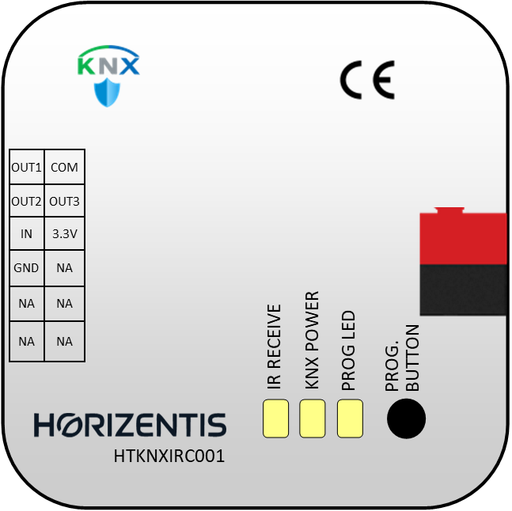
- Physical Output Selection: The macro can be targeted to one, two, or all three independent physical output ports simultaneously, enabling synchronized control of multiple devices (e.g., turning on a projector, lowering a screen, and powering up a sound system).
Dedicated AC Module: Climate Control Integration
The HTKNXIRC001 features a specialized Air Conditioning module designed for robust control and synchronization of IR-controlled HVAC units, ensuring precise environmental management.
General Settings and Protocol Learning
The "General" page allows for the selection of the AC brand and model, which automatically assigns the correct Ac protocol. Integrators can also use the Learn infrared protocol feature to automatically detect the unit’s communication language by pointing the original remote at the gateway receiver.
System Recovery: The Bus recovery action feature defines continuity after a power outage, offering options to restore the last saved state or trigger one of four predefined scenarios to quickly set the climate back to critical operational settings.
Feedback Integrity: The Send feedback for own commands parameter ensures visualizations remain accurate even when no external IR receiver is physically connected, guaranteeing that control interfaces reflect the expected state of the AC unit.
Modes and Fan Speed Control
HVAC modes (heating, cooling, ventilation, etc.) are controlled via flexible 1-byte or 1-bit objects. Status feedback can be provided via a standard 1-byte object or a detailed Hvac mode text feedback object for readable display on BMS and visualization panels.
Fan speed offers maximum flexibility via the Fan speed 1 byte object, which can be configured to use either Enumerated (numerical) values or Percentage values for precise control. Both fan speed and HVAC mode changeover objects support looping sequences, and the integrator can define whether the "Auto" mode is included in the cycle.
Setpoint and Vane Management
- Temperature: Control objects allow for incremental/decremental setpoint adjustments defined by a specific Setpoint +/- step. Critical operational stability is ensured by setting explicit Setpoint temperature lower limit and upper limit values.
- Vertical and Horizontal Flap Control: Independent control is provided for both vane directions. The 1-byte control objects allow numerical positioning. The system supports defining whether the Loop includes swing mode when cycling through flap positions, offering granular control over air distribution.
Mathematical Logic Module – The Shadow PLC
The most powerful feature of the HTKNXIRC001 is its 8 independent mathematical logic units. These units perform real-time logical and arithmetic calculations, enabling the gateway to act as a "shadow PLC" within the KNX framework, eliminating the need for external control devices.
This module is capable of addition, subtraction, multiplication, division, threshold control, comparison, and logical AND/OR conditions. It enables the rapid implementation of complex, building-specific scenarios by combining data from the KNX bus (received from sensors, contacts, or other devices) and time conditions.
Example: If the outdoor temperature (data received via the KNX bus from a dedicated sensor) is above 28°C AND the motion sensor (data received via KNX) detects occupancy, activate the "AC Max Cool Macro."
Scene and Timer Modules
Scene Module – Customizable Automation
The Scene Module allows for sending up to eight different actions sequentially or simultaneously to the KNX bus, based on the received scene number. For each action, the delay time, object type, and the value to be sent can be defined in detail. Users can save their own scenes on-site with the "scene learning" feature, allowing for dynamically customizable lighting, blind, and AV scenarios tailored to the end-user's needs.
Timer Module – Time-Based Operation and Conditioning
The Timer Module provides counter-based time management, supporting unit selections from 100 ms to hours. It can trigger automatic actions when a set limit is reached or fallen below. With condition-based enabling/disabling via a "Gate" object, it meets all your time-sensitive automation needs, such as ensuring a device powers down after a set duration.
Professional Implementation and Diagnostics
All parameters are configured through clearly categorized, color-coded pages in the ETS software, minimizing installation time. The device supports KNX Data Secure for high-integrity communication and features Easy Addressing via serial number, streamlining commissioning. With its capacity for sophisticated logic processing and precise control over up to three IR zones, the HTKNXIRC001 is indispensable for professional AV and standard climate control integration via KNX.